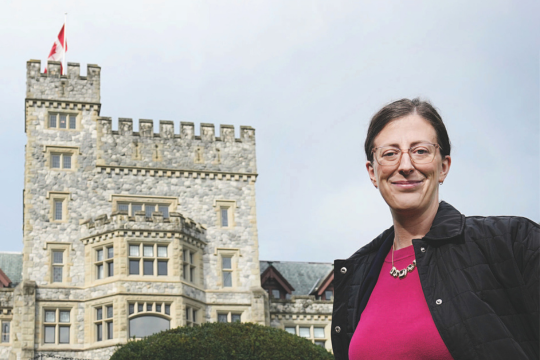
Stephanie McLean, secretary of state for seniors, plans to tackle fraud and scams against seniors, and also promises to defend federal defined-benefit pensions and promote similar pensions across the country. Photo: Adrian Lam
When Stephanie McLean was a member of Alberta’s legislative assembly, she made history as the province’s first MLA to give birth while in office. At the time, she was minister of the status of women, and her pregnancy led to changes to maternity leave for MLAs.
“It [also] really changed how a lot of the legislative assembly worked and [still] works today,” says McLean, who was serving in Rachel Notley’s NDP government. Helping to effect change like that informs how McLean hopes to do her current job as the federal Liberals’ secretary of state for seniors. She says she needs to be “a bit of an internal connector, ensuring that other decisions and other ministries take seniors’ priorities and perspectives into account.
“So that involves a lot of conversations with my colleagues, both formal and informal, about how seniors might be impacted by certain things, but also advocating for what I’m hearing is top of mind,” McLean says.
When it comes to the pension plans on which Canadians rely, the minister says she believes whole-heartedly in defined-benefit plans.
“Defined-benefit pensions are hugely important,” McLean says. “Unfortunately, there are fewer and fewer of them available. The private sector has largely moved away from them. [Defined] pension plans deserve to be lauded and held up as a gold standard, and I certainly encourage organizations to find ways to increase the access to those pension plans for Canadians.”
She says it’s important that the government focus on ensuring that the economic future of the country is in a good position, because pension investments and returns are tied to the broader global economic context and she promises to ensure Old Age Security (OAS) and the Canada Pension Plan (CPP) remain in place.
“OAS, the CPP and GIS [Guaranteed Income Supplement] are really core aspects of Canadian identity, but also, OAS is our largest social safety net program in the country. These are programs that this government is absolutely committed to, and wants to see prosper. They’re central tenets of ensuring that Canadians can age with dignity.”
As if quoting from the Canadian Centre for Policy Alternatives’ study — supported by Federal Retirees and titled The Power of Pensions — McLean says we know pension funds return money to the local economy, thereby improving the financial success of the country.
A voice for seniors
Over the course of summer 2025, McLean and her team visited the two Canadian cities with the highest number of seniors per capita in the country — Parksville, B.C., and Sidney, B.C.
They visited several different seniors’ organizations in both places and heard often about the need for technology training for seniors.
“A lot of the folks I talked to had [been reached by] the grandparents scam,” she says. “Luckily none of them had fallen prey to one, but lots of them know folks who have.”
After Sage’s interview, the Liberal government announced its intention to create a new anti-fraud strategy and financial crimes agency to investigate crimes such as online fraud, scams and money laundering.
McLean says she has a background in consumer protection — she practised law before she was elected in Alberta and between her provincial and federal political victories — and she wants to ensure the economic position that seniors worked their whole lives to achieve remains intact.
“I’m also interested in senior women and women’s health care,” she says. “We know that women’s health is something that the medical community is just starting to research.”
Important policies
McLean is a first-time member of Parliament having been elected in April 2025 when Prime Minister Mark Carney was elected. Asked about her thoughts on the lack of mention of seniors in Carney’s Speech from the Throne, she offered context.
“Canadians across the board are really concerned predominantly about the economic future of Canada and the global economic context, and particularly looking south to the United States,” she says.
“I think that’s where all of the attention really is — across demographics. There’s also been a history in ensuring that speeches from the Throne really represent different demographic interests. Ensuring that there is an office dedicated to seniors [is] sending the message to Canadians that these are absolutely priorities for the government, and that they feed into that larger picture. It’s unfortunate that that’s where the world is right now.”
Regarding pharmacare, she says the federal government has “a few agreements with provinces” and it will ensure those commitments are protected, but she is also hearing that provinces want more jurisdiction over this.
“So we’re working with the provinces to ensure that pharmacare is something that they are putting attention to, and in terms of the federal government’s part of that, the agreements that we’ve reached, we’re committed to following through.”
Federal-provincial problems
Asked what she can do about the large number of Canadians, particularly seniors, who have no general practitioner or family doctor, McLean pointed to the jurisdictional issue.
“We do the health transfers to the provinces, and then the provinces are responsible for ensuring that the dollars land where it matters in each province,” she says. “And Canada being such a large country, it can vary greatly from province to province. I think the area where, federally, we have an opportunity is with respect to targeting immigration and also ensuring that Canada is a place that’s desirable for [foreign-trained] doctors to thrive and work.”
She says British Columbia has been working to streamline the recognition of foreign credentials for doctors and nurses, for example, and has been targeting Americans for the jobs. However, Ontario recently announced it would limit first-round applications for residency positions from international medical graduates to those who have completed at least two years of high school in Ontario before studying abroad. Students who didn’t attend an Ontario high school must now wait until the second round to apply for positions, if there are any unfilled.
McLean notes that some municipalities are also mobilizing on the issue.
“I have my own opinions as a citizen, but the levers of the federal government are fewer certainly than [those of] the provinces,” she says. “The provinces are feeling the pressure, and I’m glad to see that there’s innovation happening in different jurisdictions, and the role that I can play is to encourage that innovation and to amplify the successes.”
Federal Retirees has long called for national standards for long-term care and ever since the federal government released standards for long-term care in early 2023, Federal Retirees has been calling for it to make those standards mandatory and enforceable through accountability tied to funding.
“Again, the implementation is a provincial jurisdiction,” McLean says.
She adds that the federal department of health is collaborating with the provinces on how to ensure that long-term care standards are improved.
“We certainly welcomed the recommendations. And in terms of the part that we can do again with health, it’s largely financial,” she says. “I understand we’re investing close to $200 billion over 10 years, with $5.4 billion tailored to bilateral agreements with provinces.”
On a national caregivers’ strategy, she says “the Government of Canada is committed to helping Canadians, and the caregivers and care providers [who] support them,” adding that though many of the actual programs are provincial and territorial responsibilities, her government provides “an array of support for the care economy and to caregivers, including the Canada Health Transfer, [bilateral agreements on] aging with dignity, early learning and child care agreements with provinces and territories and
the employment insurance maternity, parental and caregiving benefits.”
The secretary of state didn’t commit to developing a national seniors strategy and she said there are currently no plans to change the Pensioners’ Dental Services Plan. On the subject of government progress on fixing the Phoenix Pay System, which continues to affect Federal Retirees members, she diverted questions to Public Services and Procurement Canada. And on the Safe Long-Term Care Act, which was part of the Trudeau Liberals’ supply and confidence agreement with the NDP, she diverted questions to Health Canada. Neither department responded in time for our deadline.