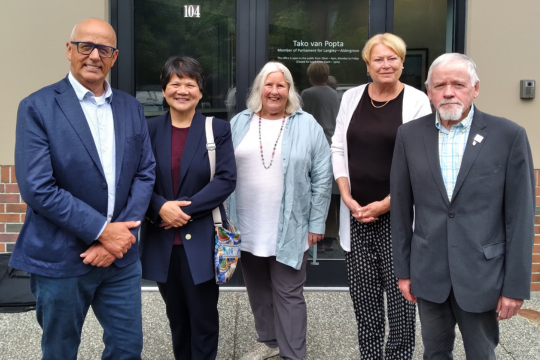
From left, MP Tako van Popta, met with constituent Angela Cheung; Leslie Gaudette, board member and president of the Council of Senior Citizens Organizations of B.C.; Linda Shiefke, a constituent; and Fraser Valley West branch president Ian Spence.
Advocacy is a powerful tool. At its best, it begins as a conversation and grows not just from policy briefs, but also from people who care deeply about their communities and the future of aging in Canada. From coast to coast, Federal Retirees members are demonstrating that influence doesn’t always start in Parliament; the relationships formed in one-on-one meetings, or across desks in local constituency offices, also make an impact.
Each discussion with an MP — whether about caregiving, access to primary care or housing affordability — builds on the last, forming relationships grounded in mutual respect, persistence and purpose. These are the kinds of discussions that can only yield positive outcomes.
The stories that follow are interconnected by the same foundation. They each reflect Federal Retirees’ priorities: retirement income security, reliable health care; positive, healthy aging and veterans’ well-being.
Together, they illustrate what it means to transform advocacy from individual action to collective impact; a network of conversations shaping the future of aging in Canada. With continued strong local and national engagement, Federal Retirees can see shared priorities turn into measurable change.
Protecting retirement income and pension security
Retirement income security remains a cornerstone of Federal Retirees’ advocacy, and members across Canada are ensuring it stays at the top of the political agenda.
With billions in pensions assets at stake, Montreal branch president Jacques Lambert and member Pierre Desmarais raised the alarm with Bloc Québecois MP Louis-Philippe Sauvé about protecting retirees’ deferred compensation. In November, former Treasury Board president Anita Anand announced that the federal government would transfer a non-permitted surplus of approximately $1.9 billion from the Public Service Pension Fund to the Consolidated Revenue Fund. The association wants to be engaged in discussions about next steps, and what to do with the surplus. For example, the government could reinvest some surplus funds into benefits for those who generated the surplus, starting with the Pensioners’ Dental Service Plan (PDSP).
By grounding the discussion in evidence and lived experiences, Lambert and Desmarais showed that pension decisions are not just abstract policy matters, but issues that directly matter to federal retirees
The team also shared The Power of Pensions report, which reveals that workplace pensions paid out $84 billion to Canadians in 2021, more than the CPP/QPP, employment insurance or private retirement income from RRIFs. This research, supported by Federal Retirees, underscores that pensions not only benefit the financial security of retirees, but also contribute to the economic stability of communities across the country.
Ensuring reliable health care
Reliable, accessible health care is essential to well-being at every age and members continue to make that point in conversations with elected officials. As demand for care grows, Federal Retirees is highlighting how health care, long-term care and caregiver support are not separate issues, but part of one continuum of aging well.
In Langley Township, Fraser Valley West Branch president Ian Spence, vice-president Robert McDonald, along with members Kamlesh Kumar and Pat Yendrys met with Langley Township– Fraser Heights MP Tako van Popta to discuss next steps on the national standards for long-term care and the importance of making the Canada Caregiver Tax Credit refundable. The conversation focused on how policy choices ripple into older adults’ realities
Van Popta agreed to raise these issues with his caucus, recognizing how closely they affect families in his community and across Canada.
Securing veterans’ well-being
Members continue to make sure that veterans’ well-being is prioritized. In Port Moody–Coquitlam, Vancouver branch president Tom Chang, vice-president Murray Bryck, secretary Danielle Rehm and branch advocacy liaison Ian Sanderson met virtually with MP Zoe Royer, who pledged to raise veterans’ well-being, pharmacare and retirement income security in caucus discussions. As the spouse of a veteran herself, Royer’s personal connection added weight to her commitment and opened the door to continued collaboration on policies that support those who have served.
More than 60,000 veterans and their families are members of the association. Canada’s veterans — including members of the Canadian Armed Forces (CAF) and Royal Canadian Mounted Police (RCMP) — deserve more than gratitude. They need timely access to benefits, highquality care and systems that recognize the lifelong impact of their service. That’s why we advocate for change — and the conversation with Royer is a reminder of the importance of this advocacy.
Recognizing caregivers and community supports
Advocacy in Fraser Valley West also showed how care, connection and persistence translate into influence. Rather than one meeting, outreach unfolded as a series of conversations across multiple ridings. Advocacy liaison and Fraser Valley West branch president Ian Spence and his team understand that to build support, our association needs to be visible.
When Spence met Fleetwood–Port Kells MP Gurbux Saini, the conversation focused on pensions, health care and roles of caregivers. Saini expressed interest in staying connected and participating in branch events. What made this discussion stand out was its emphasis on shared responsibility — the understanding that supporting caregivers and strengthening health care are collective priorities.
Building momentum for change
These relationships, grounded in community and shared priorities, are the foundations of sustainable advocacy. Taken together these meetings demonstrate the depth and impact of Federal Retirees’ advocacy on our priorities. As Spence reflected afterward, “advocacy isn’t defined by a single victory, but by steady ongoing effort.” Each meeting adds another voice, another ally and another reminder that retirement income security, positive healthy aging, reliable health care and veterans’ well-being matter across Canada. When members speak up, they open doors, inspire commitments and build momentum for change, helping shape a Canada where people can live and retire with dignity security and choice.
With Parliament back in session, these relationships and commitments will strengthen our advocacy, turning dialogue into action and ensuring older Canadians remain a priority in policy and long-term planning.