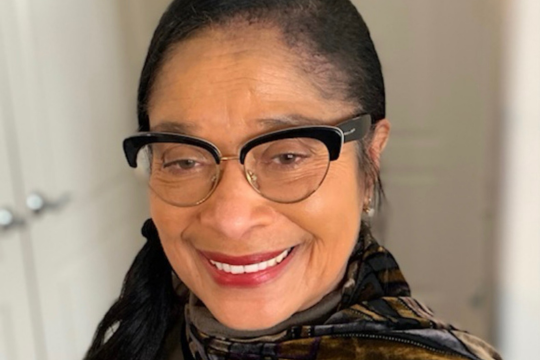
Sharon Ross has received countless awards over her lifetime, including, most recently, the Order of Canada from Gov. Gen. Mary Simon.
If Sharon Diane Brown Ross of Halifax was surprised when she received the Order of Canada last April, it wasn’t because recognitions hadn’t come at her from all directions through decades of service to Canadians.
“I was honoured, of course, and I enjoy recognition of my efforts to help,” she told Sage in a recent interview, “but I couldn’t say I appreciate one award more than another. They all humble me.”
The citation accompanying her Order of Canada said that “her professional work and volunteer efforts exemplify her commitment to social advocacy and inclusion.” The citation goes on to mention her “key role in helping racial people achieve recognition, integrity and equal opportunities within Canadian society.”
Ross, who is an African Canadian, was born and raised in Halifax, where she attended Mount Saint Vincent University, earning a bachelor’s degree in business administration. Her professional life after that was divided between her home province and Ontario, where she worked extensively for the federal government.
Her resumé is so detailed and lengthy that one can only ask Ross herself to mention the highest high points from her perspective.
In 1977, she was co-host, co-ordinator and researcher for a television documentary titled Black Insights, which dealt with a range of topics regarding the Black community of Nova Scotia. “We wanted to show people that the Black community has a rich, untold story, and I’m glad to see that the documentary is still being used in Nova Scotian schools.”
She is equally proud of her role in launching the design and fundraising campaign for the Black Cultural Museum in Halifax, which opened in 1983. “This was the first provincial building that the Black community could point to and say ‘That building over there represents the Black community’s history and contributions,’” she says.
As a member of the board of governors of the Nova Scotia Museum, Ross advocated for the creation of a new museum dedicated to the Black Loyalists, a group of Black people who came from the United States in 1783 at the time of the American Revolution.
“Everyone knows of the white loyalists, but only a few are aware that Black people were among those people who remained loyal to the British Crown,” she says. That idea eventually became the Black Loyalist Heritage Centre in Shelburne, N.S., which opened in 2015.
Ross remembers with pride the three years she spent helping the Conference Board of Canada with a 2005 guidebook on inclusion of minorities in the workplace. Titled Business Critical: Maximizing the Talents of Visible Minorities, an Employers Guide, the book has encouraged corporations to see the clear business case for fully using the talents and qualifications of minorities.
Ross has long been an enthusiastic member of the National Association of Federal Retirees, having served as a board member of the Nova Scotia Central Branch and as a health benefits officer. She recently also served on the national advocacy committee.
“The association is a wonderful vehicle for protecting our benefits and pensions,” she says. “If anything, we need more protection.”
Looking back on her life, Ross feels that her efforts and those of others to improve inclusion of minorities have borne fruit, but only to a point.
“At one time, people like me couldn’t rent a car, go into certain restaurants, or drive a bus. All that has improved, but racism and exclusion are far from dead. The work isn’t over.”