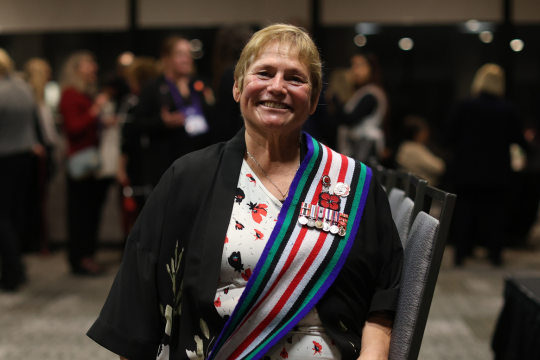
In October, Federal Retirees hosted a workshop with women veterans to share knowledge, build advocacy and form connections to advance recommendations from the Invisible No More report. June Smart participated in the workshop. Photo: Dave Chan
Hope that things will improve for women in the military and women veterans came last year with the release of Invisible No More. The Experiences of Canadian Women Veterans, the ground-breaking report of the Standing Committee on Veterans Affairs (ACVA). The report makes 42 recommendations to improve the quality of lives of women who have served.
Research Centre for Social Innovation and Community Engagement in Military Affairs at Mount Saint Vincent University, says the report should “help women veterans be less invisible.” But she also wants to make sure the recommendations are acted upon and, to that end, she’s launched a research project titled “Invisible No More: Canadian Women Veterans Moving the ACVA Report Recommendations to Full Implementation.”
Eichler, who co-chairs the Women Veterans Research and Engagement Network with Federal Retirees and Karen Breeck and is collaborating on the research project with Breeck, says while some officials have claimed recommendations are being implemented, she wants to hear from female veterans on what they see as meaningful implementation.
Eichler worked with Federal Retirees to produce the Women Veterans Engage workshop, which took place in Ottawa Oct. 30. The workshop brought together 30 Canadian Armed Forces (CAF) and RCMP women veterans from across the country. (See photos from a postworkshop reception, sponsored by Federal Retirees, on pages 24 and 25.)
Of the workshop, Federal Retirees member Breeck says participants learned about parliamentary processes and explored how to help advance the 42 recommendations toward full implementation. Breeck noted that she is looking forward to the Women Veterans Forum, typically held each March, to share the lessons learned from the workshop.
The research findings will be added to a report card to ACVA that the researchers hope to release on the second anniversary of Invisible No More’s release.
Eichler says this project represents a new way of doing research in the veterans’ community.
“It isn’t so much about studying veterans as objects, but having them participate in the research that is really about them,” she says.
“With this workshop, women veterans built new connections with each other and with the research and advocacy community — connections that will be instrumental in the meaningful implementation of the 42 recommendations of the ACVA report,” Eichler said after the event.
“It’s not our first rodeo,” Breeck added. “We know a lot of these reports gather dust on the shelf unless there are external pressures and external supports to keep them alive and make them hold government accountable to actually implement them.”
Workshop participant Louise Smith, retired from the CAF, said she was encouraged about the future.
“We talked about what’s important to us, and what we’re trying to get out of it,” she says, adding that she intends to join the volunteer group to push the recommendations.
June Smart, who wore her Métis scarf, said she, too, was encouraged by the workshop and what lies ahead.